Showing posts with label gay adoption. Show all posts

Monday, December 29, 2014

To my children on the occasion of their parents wedding.


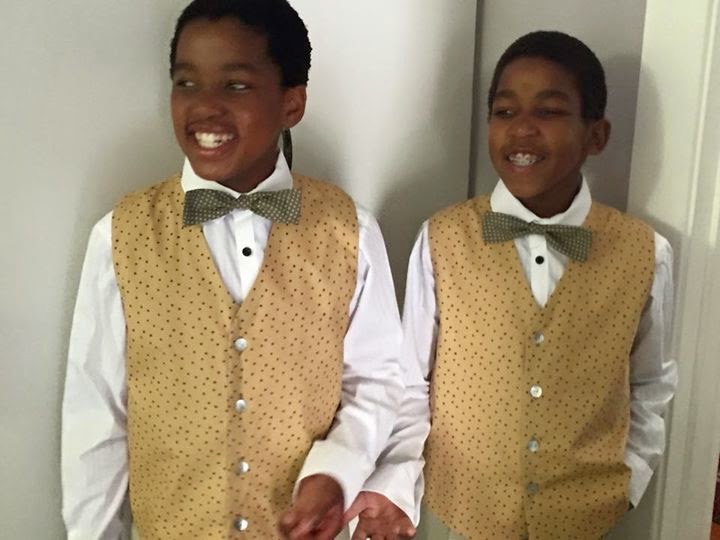
My dear Gabriel and Joshua

Last Saturday, your dads got married.  It was a wonderful wedding that we have been planning for many months.  (Well, let me be honest here – Leon has been doing most of the planning, most of the hard work – I have been nodding occasionally, agreeing with this and disallowing that, every now and again, as is my wont).

We spoke to you both about us getting married quite a long time ago.  Your reactions were not, initially, very encouraging.  “Oh gross!” you both exclaimed.  “Do we have to come?!” And finally, “Are you going to kiss?!”  But your views seem to have mellowed a little since then.  Gabriel, you baked a rainbow cake and iced it in white and suggested that we have the same for our wedding.  Joshua, you got very enthusiastic about what we were all going to wear and demanded red takkies for your shoes – not to mention matching braces.

We have come a long, long way.  Leon and my journey to this point has been almost 16 years, and our parenting has been almost 13 of those 16 years.  You have been with us for most of our relationship so far.  It is extremely difficult for me to remember what life was like without you.

I remember my own shock, when it became clear that Leon wanted children.  It was never something I had imagined for myself, believe me!  I balked at the idea of endlessly changing nappies and shoving spoonfuls of mush from bottles into gaping mouths.  I asked myself (and him!) what was the point of being in a gay relationship, if one was going to ruin it with children!  But I also listened to him.  I’m sure I was no different from any marital partner who discovers that their life partner wants children.  I listened. 

Leon made it clear that this was a non-negotiable for him.  He had to have children.  And from the moment I heard what he was saying, my life was turned inside-out and upside-down.  Because children are very different from puppies or kittens.  They start reading you from the moment they see you.  They analyse all your good and all your bad.  They take everything in and then they take over the whole of your life.

Gabriel, I can remember when we first met.  Leon called me excitedly to say that the Princess Alice Adoption Home had called him to say that they had a baby who they thought might be right for us.  I raced there.  I wanted to meet you myself before I made any decision.  I was told where your cot was and I sat beside you.  You lay there quietly, sucking your middle finger and watching me.  Analysing me.  Assessing me.  We sat like that for quite a while.  I put out a finger and you took hold of it with your other hand.  And that is when it happened.  I became your father from that moment.  From that moment my being was entirely and forever changed.  From being just an ordinary man, I became a father.

They say, when you are adopting children, in the legal documents, that this child which you are adopting is “as if born from you”.  I can tell you both, Gabriel and Joshua, that this is true.  You are both “as if born from” Leon and me.  There is no other way of putting it.  When we first met you Joshua, the social worker brought you into the tiny office she was working from.  She put you first on Leon’s lap and then after a while, Leon passed you on to me.  You were watching us both intently.

You were reading us, assessing us, forming your very strong opinion of us.  And it was then – right there in that office – that you became our son and we became your parents.  In a single moment of time.  In an instant.  It was that quick and that powerful.  You were “as if born from us”.  When I look at you, I see myself.  That is just the way it is.  It isn’t complicated.  It didn’t take forever.  It required no effort at all.  It happened there and then.  Just like that.

And so it was that the two of us started the parenting journey that has really defined most of our lives for the past 13 years now.  We got used to the nappies.  I got used to the occasional projectile vomit.  We worked our way through the pre-school and the early years, trying to do the best we possibly could for you both.  But what is seldom recognised is that you have not just been passive participants in all of this.  You have lived your lives with us too.  You have had to put up with our weaknesses and faults, along with our strengths.  You have had to tolerate our irritating ways and our foibles.  You have had to accept that we are very distinct individuals and we often have very different (and probably very confusing) views on just about everything.

You have given us completely unconditional love.  You have comforted us when we were low.  You have laughed with us, when we were happy.  You have tolerated our latest ideas and survived some of the worst of them.  You have built our family together with the two of us.  Solidly, steadfastly, through easy and through seriously difficult times.  You have co-built what we have together.

What the legal documents about adoption don’t make reference to, is the way in which adopting a child will change you – and how it will do so irreversibly.  Because my life – our lives – can never be the same again, since you came to live with us.  You have shown me things I would never have known.  You have given me more joy than is possible to describe.  You have given me more to be proud in than I would ever have achieved in my own life.  You have shown me an aspect of love that I would never have known, without you in my life.

So when people have asked your other dad and I, why we have waited until now to get married, we have answered “because it feels right to us to do it now”.  Both of you are old enough to understand what we are doing in getting married.  Both of you are old enough to be fully part of it.  Our marriage is between the two of us, but a large part of us – is you.

Our wedding was a celebration.  All the people who came there, were people who are deeply connected to our lives.  Our families; our friends, from near and from far; our colleagues from work; some of your friends and the parents of some of your classmates.  It was a wonderful celebration of our life together.  We are so lucky to live in a country where our family is legally recognised.

These are things which have been fought for.  They did not come easily, or automatically.  They have been the fruits of struggle.  For some of our family members, it has been a difficult thing.  For some of our friends, the same.  For some of our colleagues also.  These are not always easy things.
But, in general and in relation to everything that matters, the support we have received has been overwhelming. 

We wanted to celebrate our love in the communion of our friends and loved ones.  We wanted you to experience that love – that joy – that acceptance and that support, which we know surrounds us.  It is a wonderful thing, which we can all depend on.

The fact that we are married now, doesn’t really change much.  Breakfast is still going to be breakfast.  Homework is still going to be homework.  I am probably still going to be grumpy more than I should be.  But what has changed is the fact that we are now publicly, openly, in overwhelming celebration – a wonderfully supported family.  If families as happy and as complete as ours are not public – then who should be?  We celebrate the house we have built for ourselves.  We celebrate our commitment to each other and our love for each other.  That is what we did, when we married each other last Saturday.

We chose the name Gabriel, for he is the bearer of good news. We chose the name Joshua, because he is the one who leads people to complete their journey.  We chose them both because of the cultural tradition from which we have come and which forms a dominant part of our milieu, (for better or for worse). We are all what we are.  We can only try to live up to the ideals we set for ourselves, not those which have been set by other people.

But here, now, at this really important moment, let us all reflect on the wonderful thing which we as a family have built together.  May it continue to change to suit all of our very individual and different needs.  And from us as your parents, you can depend on our love for you as we grow in love for each other.  You can depend on this, for as long as we are alive to give it.

All my love

Your dad


Michael

Friday, March 29, 2013

Reflections of an ex-Christian at Easter


(Pic - "The Sermon on the Mount" from Ecce Homo. Elizabeth Ohlson Wallin, 1998, Photograph, 79" x 60")


My journey with Christianity has, it needs to be said, been a fairly robust one – on both sides, I suppose. I was born and raised in a fairly ordinary Christian home.  By this, I mean, that we went to a little parish Church within walking distance of our house.  We cooked a turkey at Christmas and had Christmas pudding aflame with brandy.  We had Easter Eggs at Easter and otherwise lived fairly ordinary, middle-of-the-road lives.  My parents were standard parents, with fairly standard ideas.  It was a happy home and the Church was a reasonable part of it.  We got baptised as infants and confirmed on reaching puberty.  If we got married, it was in the parish church. If you died, that is where you got buried from.  It was just the way you did things.

My siblings were much older than me and had gone their separate ways by the time my hormones started raging.  And when they did, they raged within the fairly safe confines of Church youth groups and choir practise – so generally, it was all relatively safe and sound.

I knew from an early age that I wanted to become a Priest.  I used to explain to my easily bewildered students, many years down the track, that it was primarily the gorgeous clothes the priest wore that had initially attracted me to the priesthood.  Of course, my motives all got dressed up in stuff the bishops wanted to hear, like calling and vocation and things like that – but actually, it was the glamour – the sheer outright drama of the thing, which did it.

I went to study theology at Rhodes University and Cambridge and Manchester.  I loved it all! I loved the academic rigour, the debate, the sheer, glorious liberation of being able to think things through and to discard the nonsense and hold on to what made rational sense.  I had some pretty amazing teachers – I think of the extraordinary Canon John Suggit.  I think of Bishop John Robinson, who was quite happy to throw the baby out with the bathwater and still was able to maintain some kind of link with both the religion and the institution of the Church (and more amazingly, was allowed to do so!)

I worked for a while as a priest in Lesotho.  In reality, it was a convenient cover for political activity.  But it was also character-moulding in all sorts of ways.  If I close my eyes, I can still remember the day I was made Deacon in the Cathedral of St Mary and St James, Maseru.  There is a point in the service, where the Deacon is required to prostrate himself before the altar.  I remember the freezing cold of the stone floor, the smell of the incense mixed with wood smoke.  I remember the overwhelming drama of the thing and the sense of dignity and communion as the massive congregation welcomed me.

I was ordained Priest in Manchester Cathedral, after long negotiations with the ecclesiastical authorities, because of my refusal to swear any oath of allegiance to the Queen.  I remember the growl of the organ and the triumphant procession.  I remember the taste of the wine at the first Mass where I was the celebrant.

So when I call myself an ex-Christian, it is not an easy thing.  I have so much of the religion etched in my brain, in my consciousness and my unconsciousness.  The images, the sights the sounds, the smells – these are a significant part of me. And I entered into it, for a massive chunk of my life, fully and passionately.  Doubtless, I would still be there, if it were in any way possible.

When a new Archbishop of Canterbury is enthroned – something happens inside me.  It is difficult to explain – but I am still connected to it long enough to remember that I have since rejected it all.  When a Pope resigns and a new one is chosen, something in my inner being awakens and reacts.  When we approach Eastertide and my child asks me about the plagues in Egypt, I react with something much more than passing interest.

And it is not that I believe in any kind of objective God, really, it is not.  And it is not that I regret not believing in God.  It is something quite aside from that.  It is a strange and eerie connection with the rich past which has made me who I am.  It is impossible to pretend that it means nothing, or that it achieved nothing or that it is worth nothing.  And I would not want to do that.

In the end, we, as a same-sex family with two adopted children, decided to cut ties with the Church once and for all, for reasons which have nothing to do with belief.  It was simply impossible to continue in it as second-class citizens and for our children to be brought up in an environment where we were not fully and completely accepted. It became abundantly clear that it would be asking too much of an institution, riven with its own lies and contradictions, on the question of sexuality – (let alone theology!).

And so, I live my life without the Church any more.  There are some things I miss intensely and many more things I don’t.  I miss the drama and the ritual and the rumble of the organ.  I miss the hieratic language and the powerful, living poetry which accompanies it.  I don’t miss the bigotry and the anti-intellectual conservatism and the lies and the all-pervading, inescapable hypocrisy, which is allowed to grow and flourish and flower and seed, without any hinder or check.

I know beyond a shadow of a doubt, that for all of it, my children – in their particular circumstance are better - much better - without it.  I am not sure I will be able to protect them from its worst excesses forever, but I am going to do my best to shield them, for as long as possible.  So they will have to be content with Easter eggs rather than the extraordinary story of hope rising from the darkness of the tomb.

Saturday, July 23, 2011

Our road, in the general direction of Damascus

I have to say, my partner was always sceptical. He experienced, first hand, the sheer awfulness of the church as a gay teenager. He says he will forever be scarred by it and he can never again go under the banner of Christian.

When we adopted our first child, a debate arose between us and our Muslim social worker, about what religion we intended bringing up our children in. Our initial instinct was to say none – and she would not have minded – she made that quite clear. But it was I who blinked.

I suggested to Leon, and he agreed, that faith, of whatever kind, is an important human thing to experience. It matters not if it gets rejected – that is irrelevant. But you can’t teach a child faith. You have to experience it, contradictions and all, for yourself.

A friend of mine told us at the time about her experience of bringing up her children athiests. She said it seemed fine for a while, but she had noticed their loneliness when things went bad, or wrong. They seemed to have no one to turn to, not even an imaginary friend. How lonely indeed.

So, we found a church. It had splendid music and some sense of liturgy and decorum. We were welcomed there and no-one seemed to make any fuss. Whatever stir one middle aged white man, a younger man and two black babies caused, was well managed. And the children would have been none the wiser.

Spurred on by baptism and early communion our boys have therefore, for several years now, attended church. I have been the one to take them, mostly. Leon would come with us on the odd occasion, and then would attend to the needs of his Blackberry during the service. Our eldest son Gabriel became a server while Joshua went through the motions in a good-spirited sort of way, but would much rather have been playing some computer game.

That was how it was for years. The church we attended in Cape Town was spikey, with lots of prancing around and doffing of birettas and a congregation whose attention was focussed forwards in the direction of the choir and the altar, rather than communal - so that suited me perfectly. Sermons were short, incidental and easily ignored. The music was good. The language was the austere beauty of the King James, which could either serve a comedic purpose or else lull one into a sense of quiet comfort.

Then came the attack. I happened to be looking for the address of one of the Bishops on the internet, when I came across an article in a blog relating to a priest, who has, for other reasons, been relieved of his licence to operate as a priest. In it, my name was mentioned, together with a list of statements about me, which amounted to an extraordinary and vicious attack. I knew I had to take action immediately.

I withdrew Gabriel from the server's guild and indicated to the parish priest the nature of the attack and the fact that we would not be returning to the church unless we could be afforded some measure of protection from this man. Silence was the response.

I approached the Bishops and the Archbishop, asking the latter for an interview. Again, silence was the response and no interview was granted. Instead, the Archbishop suggested through his Provincial Officer that I be urged to "pray" for the perpetrator of the attack. In general, bar one or two notable exceptions, silence has been the response of the parish priest and parish as well.

Now, I venture to suggest, had this attack been a racial attack, or a xenophobic attack, or even an attack against a woman - the response would have been markedly different. It would have been immediate and it would have come from the highest levels of the church. But in this instance, clear sustained homophobia, there has been silence, except for a short statement given out by the office of the archbishop, which in the end I offered to help draft.

The clear and distinct impression we have been given, as a family, is that we are not wanted. This despite mouthings to the contrary elsewhere. Homosexual people are supposedly welcome - (but more singly, than in pairs, it seems). Homosexual priests are not welcome - that is very clear indeed - (again, despite mouthings to the contrary). And homosexual priests with a heathen partner and two adopted children seem to deserve no protection from homophobic attacks by another priest - within the ranks of the church - and who is quite obviously in need of psychological care.

I withdrew immediately from the church, and as I had guessed, this priest came looking for me on Sunday mornings at Mass. Had I and my children been there, there would have been, I am quite sure, no protection from him. It was not a risk I was willing to take and certainly not one I was willing to expose my children to.

At the start of this whole situation, Leon had asked a fundamental question. He asked "What kind of an institution is this, that we are exposing our children to?" And I had to admit, it was not a safe one for them, or us. Now, it is doubtless true that they will be exposed to a whole range of issues and problems throughout their lives. They will doubtless encounter homophobia in their schools, on the sports fields, etcetera etcetera. But that does not mean that we should be actually seeking out places for them to be abused? The church is clearly one such place. It is not a safe place for them, or for us. But more than this, the church is an environment where gay and lesbian people are second-class citizens and that is intolerable.

From the perspective of faith, well, that is something one must mould for oneself in any case. And my life is not, and never has been one which depends on a faith in God for its goodness. I have not quite worked out how we will be explaining to the children why we don't go to church anymore - but I guess the truth won't hurt them. I might just say this to them - that the church just wasn't a safe place for us. We can do much better elsewhere.

Friday, December 24, 2010

And a child will lead them

I will never forget the moment, some 10 years ago now, when our Muslim social worker asked my partner and me the casual question - "And what religion will you bring the child up in". We were in the process of adopting our eldest child. We had not even met him yet. We were going through what seemed like a rather long process of being prepared for parenthood.

Being amongst the first Gay male couples to adopt a child in this country - the territory was rather new - for the social worker as well. They wanted us to "practise" for a while - and so for several miserable weekends, we were asked to go to the adoption home and feed the children. Dear Lord! It was a nightmare. I think they thought if we could survive that, we could survive anything - (I know that thought crossed my mind several times). But having passed the test, we were now looking at the nitty gritty of adoption. Who was likely to be the primary parent? Who was likely to provide the discipline? Etcetera, etcetera.

The innocent question about religion caused a three week break in the process, while we discussed the matter. Backwards and forwards it went. My partner, Leon, loathed the Church. The Church had almost proved his mental undoing, in its lack of care for him; in its homophobia; in its dreadful hypocrisy and alienation of Gay and Lesbian people. He was very uncertain indeed. On the other hand, he was pretty much at sea from a religious perspective. A kind of wannabe "spiritual" type, with not a great deal of focus, or specific practise to offer.

I, on the other hand, had been a priest - had studied and taught Theology for gazillions of years and had left the Church the moment the struggle was over. What was the answer to the Muslim social worker’s question? The truth is, it was an inoffensive question. She wasn’t expecting any particular answer. We could have said “None!” and we would just have moved on in the conversation. But we decided to interrogate the matter with what was, for both of us, surprising intensity.

We discussed the nature of faith. We discussed the practise of belief. We discussed our own journeys – the positives and the negatives. And we came to a decision – strange in the eyes of many and peculiar, sometimes, even in our own judgement. We decided that we should raise the children in the context of the Christian faith –despite our own serious misgivings.
And so that is what brought me back to the Church. A baby. The absolute epitome of human frailty and human need. A baby, with a newly minted laugh and eyes so clear, you could see eternity in them. A baby that came into our lives, to change them forever.

We called him Gabriel – and it is his job to put the angel on the top of the Christmas tree every year. We called him Gabriel, the harbinger of good news. We called him Gabriel, because that was the first name we agreed upon while flipping listlessly through a bible one Sunday in Church, during a boring sermon.

And tomorrow, Gabriel will be serving at the High Mass on Christmas Day, dressed in a cassock and surplice and looking utterly angelic, smothered in incense and feeling the surge of the Haydn “Jugendmesse” and the swirl of hieratic language. Of course he may, one day reject it all. That will be his choice and that will be his unquestionable right. But when and if he does so, it will be from the position of an insider. He will know the stories that form such a massive part of our philosophy and our culture, for good or for ill. He will understand why some people pray to a God and have hope for the future and show love to their neighbour. And, hopefully, if he does reject it all, he will be a better person for having taken what is good in religion and making it his own.

Of course, there are dangers. It is also possible that he will imbibe the bewildering levels of prejudice; the terrible bigotry and the hatred, which is also part of religion. It is possible that he will start to see himself as superior to other people. It is possible that his brain will start to ossify and become closed to science, and change, and possibility. That is also a feature of religion. But it is bad religion – and I hope that he will be enabled to see that and to reject it.

In the meantime, I will thrill at the sight of the child I have been entrusted with, dressed like an angel, doing his service with a diligence and dedication that really inspires me, when together we pause at the crib of another baby. A child who, it is said, can lead the lion and the lamb to find peace with each other. That is an ideal I want for Gabriel. That is a vision I want for myself.

Saturday, November 27, 2010

Priscilla revisited

For those of you too young to remember, “The Adventures of Priscilla, Queen of the Desert” is a 1994 Australian movie, starring Hugo Weaving, Guy Pearce and Terrence Stamp. It involves two drag-queens (Anthony/Mitzi and Adam/Felicia) and a transexual (Bernadette) who are contracted to perform a drag show at a resort in Alice Springs, a town in the remote Australian desert. They head west from Sydney aboard their huge bus, called “Priscilla”. En route, it is discovered that the woman they have contracted to do the work with is Anthony's wife. The bus breaks down in the middle of the desert and gets repaired by a salt-of-the-earth type called Bob, who travels on with them. We decided to watch it last night, with our children, aged 7 and 8– one of whom has, since a very young age, shown a serious interest in cross-dressing.

Now, immediately, there were some issues. Firstly, the movie far from clean in its language. Secondly, it deals with cross-dressing as a major theme. And thirdly, some of the situations these drag queens get themselves into could have proved themselves a little difficult to explain to a child. So then why did we do it, and how did we justify doing it?

Firstly, we dealt with the swearing. Both the children know words like “Fuck” and “Shit”. (It is not unknown for me to use them myself – but I certainly do so only by mistake in front of the children. And we frown upon others who might not have children and not be practised in the art of avoidance of words like these in normal conversation). Both children have demonstrated to us that they are aware of words such as these and we do not allow them in the house at all.

On the issue of cross-dressing – well, this is an issue we had had to face in the life of one of the children from his earliest years. Neither my partner, nor I cross-dress. Nor do we have any men friends who do so - (with women, it is sometimes a bit hard to tell whether the cross dressing “line” has been crossed or not).

But our child has just always done it! He would twist a T-shirt into a boob-tube. He would turn anything available into a skirt. One Christmas a friend gave him a wig, which we could almost never get him out of. It got so serious that, at one point I called a sexologist for advice. She listened to the story and said, firstly, that counselling could not start until the age of 9, and that gender reassignment (if that was the outcome of it all) was not possible until after the age of 20. (At this point, I was hyperventilating!). And that (and here was the real nub of the matter) perhaps I “should just get used to the idea that I might be living with a transgendered person”.

Our response to his cross-dressing has always been neither to encourage it, nor to show disapproval. We have simply allowed him to do it, if he wants to, in the home. I note that it seems as though social pressure outside the home (such as the school, for instance) may well have made him stop the behaviour. Because, at the moment, I can see that what used to be an almost daily occurrence, has now virtually disappeared.

Then why would we want him to see things like Priscilla? Do we not stand the risk of reinforcing a behaviour that is now apparently, a thing of the past? We don’t think so. But we did manage the process and intervene on several occasions to explain what was going on in the movie.

Both children watched it through to the end, and both said that they enjoyed it. When the younger one asked why “those men are wearing girls clothes” (despite that fact that he has grown up with his brother doing it all the time), we explained that that is what some men wanted to do. It made them feel good and it made them like themselves. And that it really doesn’t matter what people choose to wear.

That settled, the movie continued and we laughed at the funny bits and felt sad at the sad bits. When the trans-sexual (Bernadette) confronted a bigot who was threatening her, our eldest said “she’s gonna beat him up!” And she sure did, much to everyone’s great enjoyment.

As for “Priscilla” itself – it was a bit strange to be taken back into a world where neither cell phones, nor computers were anywhere evident. And the issues which came up in the movie, many of them, demonstrated how much further we are all conceptually. For instance, they have obscenities painted on their bus, which link them to AIDS. No-one in their right mind would necessarily put the two together anymore. Similarly, the issue of being in gender transition seems to be much less of an issue today than it was then.

Or maybe not. Maybe it is just me that has grown a bit older and a bit wiser. Whatever the case, we want to create a home environment where our children can know that nothing they choose to wear, and nothing that they authentically are, will ever put them outside of our love.

Sunday, August 1, 2010

What about the Ancestors?

I remember that day very clearly. An excited call from my partner, Leon, saying “We have got a child”. I went into panic mode. I had made my position very clear, both to him and into Social Welfare. I wasn’t going to have just any child thrown at me. I wanted to be sure that I could “bond” with the child first – not that I had the vaguest idea of what that might mean.

So I went to see this child, which they thought would be right for us. He was lying quietly in his cot at the far end of the room, sucking his finger. I looked at him. He looked at me. After a while, I put out my finger and he took hold of it. And at that moment – that instant – I knew that this child was mine. I knew that I was his father and he would be my son.

When we adopted our children, the legal wording of the adoption order was, for me at least, very important. It said that this child was now “as if born to you”. The ancestors of that child (and the state) for whatever reason, handed him over to me and my partner. Our children were not “abandoned”. They were consciously and lovingly handed over. Those children are now mine - “as if born to me”. These two black boys now have two white fathers.

And it happened quite naturally, fairly early on, when I was asked by one of them about the identity of an old white lady in my photograph album, that I explained that she was my mother. “Your grandmother”, I explained, “she died a long time ago”. And we moved on to the next set of pictures. “And that is your Aunt, and that is your cousin…” and so it went.

Both the children refer to Leon’s parents, who are much more to them than pictures in an album - as “Granny” and “Grandpa”. And Leon’s parents make no distinction between our children and the children which his brother has produced biologically. Our ancestors are now the children’s ancestors. They have no others.

Of course besides anything else, the question of culture has also come up fairly frequently. Just because of the fact that these children happen to be black and me white, do I need to start doing a course in gumboot dancing? Should I rush off and get myself circumcised? Should I have a regular supply of Mopani worms in the house to make them feel secure? This is as crazy as it is bizarre and it reveals, I am afraid, just how far we are away from a really non-racial society, where colour is the least significant thing about a person.

No, we are not there yet. And yes, I have no objection to “exposing” my children to cultures other than my own. I also have no illusions about the difficult path they will need to tread. They need to be secure, not in some fantasy culture from somewhere else, but in their own skin, for who they are. And force-feeding them Mopani worms will not make it easier for them. It may make it a whole lot worse.

Saturday, January 16, 2010

The things we can trust


Last night, our family went out to dinner to celebrate our eldest son turning 8 years old. Leon’s parents took us all to a Pizza place – a really nice one, which was empty enough for the kids, together with one of their cousins, to run a little wild, without frightening off too many patrons.

Gabriel had a very busy day, and by 8.30, he was tired. He came and sat on my lap, for a while (as he seems to be doing these days) and then he stretched himself out on the bench next to me, and fell asleep, his head resting on my lap.

I looked down at this sleeping child and I started to remember our 8 year history together. From that tiny 3 month old baby lying sucking his finger in the Princess Alice Adoption Home, to this fairly confident boy, whom I recently went to watch doing cartwheels around the stage.

There is nothing, no words, no sound I can make - nothing I can write or explain – which can describe these kinds of moments. Every parent knows them. They seem to be something which the depths of our human being recognises and treasures. If you do not have children, or have not been attached to children in this kind of fundamental way, you will not know what I am talking about. It is so extraordinarily powerful. It is overwhelming. It is humbling. It takes one back to the very depths of one’s own being and life experience.

I put a post up on Facebook about it and a friend replied that the picture I posted evoked in him some of his most secure childhood moments. I responded, saying that what made me really sad was that Gay and Lesbian people, generally, do not experience it. Indeed, I would have never experienced it had Leon not insisted on children.

Another friend, whom I told the incident to, and the profound effect it had on me said, “isn’t it wonderful – that complete trust”. Indeed, it is wonderful, that I can be Gabriel’s secure place – even if only for a few simple and precious moments.

Tuesday, December 22, 2009

Questioning my own position


So, it is now holidays. This means that the child-minder has gone off to enjoy three weeks of holiday in Limpopo – well over 1000 kms from where we are; it means that Leon and I are also on holiday; and it means that the children are not at school. It is a recipe for stress, believe me.

We have done Ratanga Junction. How can I describe Ratanga Junction? “Hell”, would be too easy. In fact, “hell” would be too kind. It is more like taking your brain out, putting it through a shredder and then putting it back in your head, while at the same time using a set of pliers to tear pieces of flesh from your body. And, lest I forget the particular form of torture they seem to have perfected at Ratanga Junction – they force you to listen to indescribable music, which is broadcast from hidden speakers in the foliage, so there is no escape.

Most of the experience is standing in very long snaking queues, full of large parents stuffing themselves on hot-dogs together with fractious, over-excited children – in the baking sun. Then what you do is, you get to go on a ride. Now let me say, right away, that nothing on Gods Earth would make me go on one of these rides. They seemed either to be so tame as to be mind-numbing, even for the 3 – 6 year-olds for whom they were intended. Or, so utterly vicious that I felt my stomach heave just watching them!

There were log boats that got dragged up what looked like mountains to me, and then left to plummet down into a water filled gorge below. (A sign warned, helpfully, that you would get wet on this ride. Indeed, said the sign, you may get soaked). There were twisting things, which seemed designed to make you throw up. There were plastic bubbles in a pond, which you got into, and into which via a kind of reverse vacuum machine, they blew in air and then zipped you up, so that you fell about trying to stand up (An extra R20, that one was). On the other hand, there were silly aeroplanes which went round and round in a circle, at different levels, depending on what you did with the joy-stick; and stupid looking miniature game viewing trucks, which were on a mono-rail.

Needless to say, my children had a ball. More than a ball. Two balls! They want to go back! Oh, woe is me!

And then today, worn out by yesterday’s fairly extreme experience, we decided to let them choose any DVD they wanted to from the DVD loan shop. The youngest boy (6) chooses something about Dinosaurs. Well and good. The eldest (8) chooses Barbie.

Now, I suddenly find myself thrown into a quandary. Why a quandary, I ask myself? If he wants to choose Barbie, then let him choose Barbie! He chose it, I noticed, in a somewhat surreptitious way. The system in this particular DVD loan shop is that you choose your DVD. Then you take whatever box is behind your chosen DVD to the counter, for them to insert the actual DVD. The box you take to the counter is anonymous, in that you can’t tell what the DVD is by looking at it. It was this box which he brought to me. Not wanting to have him watch the axe murderer, because of a lack of supervision on my part, I did my parental duty and demanded to see the actual DVD he had chosen. He pointed out Barbie.

Now there was a millisecond – I have to confess – when my instinct said “Barbie! For crying out aloud! Why would you want to see Barbie?!” But I didn’t. I said, so quickly that he would not have noticed the millisecond’s hesitation, “OK, that’s fine”.

Later, ruminating on the matter, I said to my partner – “Should I have shown disapproval?” He looked horrified! “No!” he said, “that’s exactly the way you would open the closet door!”

Of course, he is completely right. The moment my child detects disapproval, on my part, he will hide it. And that I would not want. So, as it is as the moment, he likes Beyoncé and dresses up like her. He likes Ballet and did it last year at school. He wears a long-haired wig a friend of ours gave the kids as part of a range of dress-up outfits. He is happy when he does these things and he does them in front of us. We have taken the carefully thought through position, that we will neither encourage, nor disallow the behaviour. That, it seems, is who this child is.

But it was my own reaction to his wanting Barbie, which was so intriguing. I am a gay man. I know about gender and stereotypes and about gender roles etc. I know about prejudice. I know about homophobia. But I want to tell you, in spite of all of that, the homophobe in me, is pretty close to the surface. It springs out and confronts me when I least expect it. I may not like it. I may not want it. I may thoroughly disapprove of it and intellectually disavow it, but it is there. And like racism, the thing I need to do, is to keep it in very firm check, so that it does not affect my children.

Monday, October 5, 2009

Trans-racial togetherness

After much to-ing and fro-ing we were invited to attend what was described as a “trans-cultural” adoption group yesterday. Now, what might a “trans-cultural adoption group” be, you ask me?

Well, this particular group was one where white single mothers, who have adopted black children have got together on a monthly basis – for reasons of support, I suppose. I would have called that a trans-racial adoption group. The fact that they call it a trans-cultural adoption group is cause, I would say, for some concern. It goes back to the substantive matter of whether or not culture is racially defined. This, after all, was one of the fundamental tenets of apartheid ideology – that we are all racially and culturally separate-able and circumscribable. It then took it further. It said that culture was something fixed for all time. It was something which was defined primarily by skin colour, and once defined, it was something one could not escape.

Now, to assume that the culture of the children in this group - because they happen to have black skins - is of a different culture to the parents with white skins, to my mind, is highly problematic. There was even some casual discussion, in the group of nodding in the direction of the “culture” of a particular child. So, I heard that one child’s biological background was Zulu. I wonder what, in reality that is going to mean for the child? Lessons in Zulu dancing? I discovered, when I did a DNA test of myself, that I had Croatian roots - what on earth does that mean in my life, other than vague curiosity?

We were invited to the group somewhat curiously, being neither single nor mothers, you understand. We went, because we feel it is in some way important for our children to understand that they are not alone in the world – that there are other families like ours. But the problem is, what happens when there are some fundamental discordances relating to values? Is that something we want them to be exposed to as well?

As it was, the leader of the group revealed that there was some issue about us being a same-sex couple. Apparently there was some discussion in the group about having men in the group, because there was a lack of male role-models. When our names came up, apparently, one comment was “but do we really want two gay men in the group?” Again, it is really a question of values. Of course, in the real world, our children are going to need to realize that not everyone is accepting of gay men parenting children (trans-racial or not). But do we want to belong to a group where some of the parents are not completely affirming?

It’s difficult. This is, after all, Cairp Tahn. This is one of the most racially divided spots on the African continent. So, there is some sense in taking what is on offer. But does that mean that values need to be compromised as well? I really don’t know. I suppose I also have some missionary zeal left in me, which means that I still feel constrained to convert the infidel, but does one do that in the context of one’s children? That is a question which we will be considering in the next while, for sure.

Saturday, October 3, 2009

Seapoint nostalgia


Pix: Our children Joshua top, age 6. Gabriel below, age 7
Anyone who has lived in, or, I suppose, even visited Cairp Tahn in the good months of the year will know that promenading the beachfront in Seapoint is one of those things you have to do before you die.

The promenade is busy on good days. Joggers, those with good and those with indifferent bodies; walkers; strollers; amblers; beggars; parents kicking a football; children having a football kicked at them; dog walkers a-plenty; ice-cream eaters. There are a lot of people there, if the weather is good.

The actual beach should really only be looked at. It is completely shale, with jagged rocks and pools of slimy green, littered with a few plastic bags. But if you look beyond this – then, Ah! And if the sun happens to be going down, then double Ah.

For myself, I have these really strong and close to overwhelming feelings of childhood nostalgia, because as a child of (I suppose 6 or 7) my parents and I boarded a train and headed for Three Anchor Bay – which is right next to Seapoint. The 2 day train journey (I remember) seemed utterly interminable. We had lorry loads of boiled eggs and flasks of rapidly cooling coffee. On the second evening on the train, we went to the dining car for our meal. There was silverware service, involving waiters in crisp starched white jackets with shining metal buttons. The train seemed to stop endlessly and the Karoo stretched on for mile after never ending mile.

I remember my mother “writing away” to the owner of our intended lodgings in Three Anchor Bay. I remember the answer arriving saying that we were duly booked. My parents would only call Cape Town in the case of a death in the family and even then, the tension caused by what was the imagined cost of the call was unbearable. The conversation would be clipped, fulfilling of all the required sympathies and niceties, but the receiver replaced as soon as was decently possible.

My nostalgia began, I think, when I suddenly remembered some of the stories I had heard about that trip. Like being rescued from the sea at Three Anchor Bay, when I fell off the rocks. Like me vomiting on (and consequently completely ruining) the carefully prepared Christmas dinner my aunt had made for us. Like the trips I had on the little miniature Steam Train. Like the huge live crayfish I and my father went to fetch from the fishing boats early in the morning.
And I remember how unimpressed I was at my first sight of the sea, because from the road along the beachfront, all you can really see from the car is the line where the sea meets the sky.

That was then. And then some 45 or so years got in the way. And when Leon and I are promenading on the Seapoint Beachfront, I can’t help wondering what, if any, nostalgia my children will be having in the year 2049.

Sunday, August 16, 2009

Gender issues and children

Our youngest, Joshua (alias "Bin Laden"), is having his 6th birthday tomorrow. Being Sunday, we pretended it was today. He got weird things called "Bakugans" which are extraordinarily expensive plastic balls, which, when placed on a specific card - open up into some kind of robotic thing. (Apparently, the card has a magnet in it, which allows it to do this). Personally, I can't see the attraction - but then I'm not 6.

Another present which he had been given by a friend was an assortment of wigs and various bits and pieces of a wizardry outfit. He wasn't in the slightest bit interested in the wigs - but our eldest child (7), Gabriel, was. In fact, he has worn one of the damn things the entire day. It is, for him, the equivalent of someone paying off my bond; a night with Brad Pitt - you get the picture.

We have such completely different children. Josh is a boy - completely, uncomplicatedly and with no discussion necessary. The other, from the day he was born, has been fairly undecided. No, I am being a bit too vague here. He has always been completely absorbed and fascinated by the feminine side of his personality. (The male side is often, quite hard to see).

So, what have we done about it? Well, we have taken a couple of decisions in relation to the both of them. Firstly, we have allowed them to be who they best feel they are, within the space of the home. So, when Gabriel insists on turning ordinary pieces of clothing into girl's fashion pieces, we let him do it. We don't praise him, but we also don't forbid him or censure him. His brother looks at him like he is out of his mind and never participates in the dressing up regime. We allow him the space to do that as well.

Sometime into the business of parenting of Gabriel, I started to get alarmed by his behaviour - he could not have been more than 4 years old. When I spoke to friends about it, I was told "It's perfectly normal. It's just a phase". Eventually, I called a gender specialist therapist and talked to her about the behaviour. She listened attentively and then said the following" She said "Maybe you just have to reconcile yourself to the fact that you are living with a trans-gendered person". I swallowed hard and realised that she was talking the truth.

She said that counselling could not begin before the age of 9 and that (and this really got me agitated) gender re-assignment could not be allowed before the age of 20. Gender re-assignment! Dear God! How radical is that? I said to my partner - "Can't he just be Gay, for God sake?" But I realized immediately, the stupidity of what I was saying.

The fact of the matter is, our eldest child has, since he was able to move, explored every possible angle of being a girl. In dress. In the way he walks. In pretend "modelling". In speech and mannerisms. That is what he does.

He doesn't seem to do it all the time. But it is a constant and certainly not something one could ignore. We thought, at one time, that he crossed dressed when he was feeling insecure about something, but I don't believe that any more. He just does it. There is no pattern as to when he does it.

When he first went to primary school, he wanted desperately to fit in. He cut off his dreads and looked very much like a boy. He gave up ballet, (which at pre-primary school, he loved). But the boy phase didn't last very long. He is doing ballet again and cross-dressing at will. So, perhaps I need to come to terms with what the therapist said - and just get used to the fact that my child may be trans-gendered. For him it will be a long, hard path, if he is. For us, it won't be an easy path either - but at least he has parents who won't judge him.

There will be those, of course, who will argue that it is because he has grown up with same-sexed parents that he has these peculiarities. It is, of course, a silly argument, because many trans-gendered people have grown up in heterosexual environments. It also wouldn't explain why our youngest son is so absolutely male. My view is, that is just the way he is and we either support him, or he has to swim on his own.

So as I curse my friend for having delivered a variety of wigs to our home, for whatever reason, Leon says to me, simply, as I cast my eyes discretely heavenwards, "It makes him happy". Maybe, in the end, that is all that really counts.

I don't want to write any script for him. I want him to be the person he wants to be. So, it could be the easier path - he could suddenly enter another, much more obviously male phase. Or, he may not. Either way, we will be there for him.

Sunday, August 9, 2009

A new child

Jacqui and her new son Amila

The moment - Jacqui's mother, Bernadette and brother Andrew holding Amila.
My friend Jacqui has just adopted a child. The waiting for this moment has been long and laboured. I wonder why this seems to be the norm? I wonder why, in a country wracked with HIV, poverty, unemployment, violence and often completely unthinking sexual behaviour, it seems to take the social services so incredibly long to sort out the match between obviously able parent and obviously needy child?

It was really no different in our case. Despite that fact that I kept on changing my mind about it, when all was said and done and decided, we still had to wait months and months for our first child. And the second spent months and months waiting for us apparently, because we could have taken him three months before he actually was given to us! Those three extra months, were fairly critical in his development. When 6 month old Joshua arrived, he was a bit like a zombi. He seemed to have no emotions. He just stared around him - never crying, or gurgling, or doing any of the other social things which babies of 6 months are supposed to do.

Luckily, the light did switch on - and Joshua today, is the most animated child imaginable. But there has been damage. His motor movements are not what they should be. His writing and drawing is extremely bad and he needs Occupational Therapy to see him right. All because of the level of under-stimulation which he received in those crucial early months.

Jacqui's little boy (named by his birth-mother, Amila) has been in foster care - and though this might mean that he has other problems, he certainly does not seem to be under-stimulated. He is bright, alert, aware and self-confident. A beautiful little boy.
As we sat there, in Jacqui's maginificent Hout Bay house, overlooking a wonderful valley, amongst her friends and family, I could not help think back on the welcome parties we had for both our boys, some 6 and 7 years ago now, and started to enumerate in my mind the absolute joy which these children have brought into our lives. As I have said before, in previous postings, I may not be the world's most natural parent, but our children have undoubtedly made me a better, a more fulfilled person. A more whole person. That is what children can do, it seems, if you let them.
I remember the first time their grandparents met our eldest child, Gabriel. What we were doing was not the expected. It was, perhaps, not what they had dreamed for their son. They came from Harding - a tiny town in KwaZulu-Natal. Their exposure to situations like this was limited. But if they did have difficulties, though, they had determined they would overcome them. And they have proved themselves to be the most supportive and most loving of grandparents through the years.

I watched as Jacqui's mother arrived, also from KwaZulu-Natal, to meet her grandson for the first time. I watched her eyes, as they first set eyes on her new grandchild, Amila. If there was uncertainty before, (and there must have been) there was none at that moment. Because immediately, the bond had happened. I spoke to Jacqui about this two nights ago. I said to her, wasn't it amazing how that thing happens? That thing which is hard-wired into our make-up as human beings. The way in which once you meet your child, you change as a human being. You cross from being an observer, to being a player. From being a relative, or a friend, or a helper, or a next-door-neighbour, to being a father or a mother. The switch is thrown. You will never be the same again. And then a grand-mother or grand-father. You have changed into something else. You can't ever go back.

On our children's birthdays, Leon and I write a letter to them in a book. We write about what is happening around us and what is happening in our lives. We write about our pains and our sorrows and our joys and our pleasures. We tell them about themselves - what we see in them; what we hope for; what they have done in the past year; what they have said, what they have achieved. We will give it to them, when they are 21, as a word-scape of our journey together. Because it has been, so far, a wonderful one.

Our children, Gabriel and Joshua, are both very different from each other. I have no doubt that they will journey on very different paths. But, for sure, the one thing which will bind them together is Leon and me, and our family and families. That is a constant they can rely on.

And so, Jacqui, I welcome you to this strange and bewildering state of being that is parenthood. I know, without any doubt that you will face both joy and anguish. You will know love (like you have never known it before) and moments of the deepest despair. And above all of that, you will experience the thrill of guiding another human being on this exciting path called life.

Tuesday, August 4, 2009

Riversdal: The Beauty and the Beast


Riversdal was named for the Civil Commissioner of Swellendam, Sir Harry Rivers, in 1838. It is a tiny little town, with a population of some 7000, on the N2 between Albertina and Mossel Bay. There seems to be some confusion amongst the locals about whether it is Riversdale (which would be the English version) or Riversdal, which would be the Afrikaans. I suppose it is either. But it is not "Riviersdal" - which would refer, not to a man going by the name of 'Rivers', but rather to the Afrikaans word for 'rivers'.

The houses in the centre of the town are really beautiful. The pictures I took are from just one of the streets I and a colleague walked down. "Couldn't you imagine bringing up you kids here?" she asked. I thought for a minute.

On the one hand, yes, of course I could. The houses all have low walls, if they have any walls at all. The gardens are huge. The town is picturesque and framed with mountains on either side. The fields lush and green. It is tranquil and idyllic.

But then I remembered that this is the town where one of the first Gay couples to legally marry in South Africa lives - (their names are Vernon Gibbs and Tony Halls), and I also remembered reading some time ago just how much stigmatization and ostracising they had to go through, living here. I hear that they have become more accepted over the years, but it must have been hard. Would I want my black adopted children with two male fathers to grow up here? No, I would not. Cape Town is tough enough.

Friday, July 31, 2009

Gay-friendly fairy stories

Some years back, I went to fetch my son, Gabriel, from his school for a doctor’s appointment. Now let me explain – Gabriel is adopted. He is black. I am white. The school he went to then was almost completely black, barring most of the teachers.

So, I arrived. My younger son, Joshua the extrovert (at the same school, also black, also adopted and, I suspect closely related to Osama bin Laden) rushed up to greet me. Gabriel is much more reserved. He was not unpleased to see me, but concerned, I think, to look in control of the situation. He sauntered up to me, case in hand, and as we left, I heard one of the children shout “Joshua and Gabriel’s daddie is white!”

Now that, I suppose, is a fairly big issue, in an almost all black school. The good thing about them going there is that they consider us (my white partner and I) to be the strange ones. They, on the other hand, are very comfortable in their skin. On the question of my partner and I both being male, we had some nervousness initially, about the school, when one of the kids came home one day saying that they had been talking about families at school. We phoned the school first thing the next morning. We wanted to know whether there might be any difficulty with our situation. “Oh no!” Said the principal, “The class was talking about who had a daddy and who had a mommy and things like that. And Gabriel was pleased as punch, because he had two daddies and most people in his class had none!”

We have sometimes wondered how we should handle the matter, should it come up, with the kids. The other day it did. Joshua at dinner, one evening, suddenly started talking about his mommy. We all turned to him, wondering what he was going on about. On he went – his mommy this and his mommy that. His brother had been quietly considering him for some while. Suddenly he shouted at him “You don’t have a mommy! You have two daddies!” Joshua shut up and that, in a nutshell, was that!

I was interested to read, some time ago, about books which are now being introduced in UK schools, introducing children from as young as 4, to gay and lesbian issues – the so-called “No-outsiders” project, which ended in March 2009. Naturally, conservative religious groups and people are huffing and puffing. “It is tantamount to child abuse!” said one. “It is propaganda designed to warp children’s minds”, said another.

Now our connection with the project is, I admit, slight. But it was enough to make me read the article with some interest. My partner has been very concerned, from the beginning, that our children should grow up seeing themselves (and us) as normal - as indeed, we are! Our family is as “normal” and “ordinary” as you can get. The kids get up every morning, have their breakfast and go to school. When we get home from work, there is the usual stuff that happens in every home with children. Joshua "bin Laden" gets shouted at because he is breaking something; there is a fight over eating healthy things on their plates and bribes with ice-cream to follow if they do; there are demands for cooldrinks after the magic hour of 5pm, indeed there is extreme resistance to going to bed at 8.00pm - and so it goes and so it goes. Just because one of us doesn’t wear a dress as parents, doesn’t make the slightest difference to the sheer normality of the situation.

And there is the bed-time story. My partner scoured the internet and found several storybooks which we read to them, along with Cinderella and Jack-and-the-beanstalk and all the other usuals. One is called “And Tango makes three”, which is a sweet (apparently true) story about two male penguins in the New York zoo. The zookeeper notices that they don’t seem to like the girl penguins very much and instead seem to prefer each other. They set up a nest together. Together, they try to hatch an egg shaped rock unsuccessfully. The kindly zookeeper takes pity on them and puts a real egg in the nest which they made for themselves – which they successfully hatch this time and raise a healthy chick called Tango – because it takes two to tango.

Another is called “King and King”. An elderly Queen decides she has had enough with ruling and that her only son should take over. She arranged for all the likely Princesses in the land to process before him, so that he can choose a suitable Queen for himself. No-one seems to catch his fancy. Would-be Queen after would-be Queen comes and goes. The son and heir is bored to distraction. But one day, a young hopeful just happens to bring her brother with her for support, and it is love at first sight! They get married and everyone lives happily ever after. And everyone called them King and King!

The last one is called “The Sissy Duck” and it is about a male duckling who likes cooking, cleaning and art. Now, as I say, we read these to the children periodically, mixed in with all the other favourites. I can’t say that they leaped up and down with enthusiasm when we read these particular stories, but they each had their own favourites and prefered those to all others.

And the point of it all? Well, just that what we are doing, and the life we are living - feels terribly ordinary. Because that is what it is! And it is both a pity, and I would say ridiculous, that there isn’t a range of literature and other support mechanisms, which would help to support that ordinariness.

My partner recorded bits and pieces on the TV about the Ellen Generis marriage. We encouraged the children to watch - giving no comment. His point was that they need to see that who we are is not something odd or entirely unusual. There are other people in the world who are also engaged in the same kind of relationship that their parents are.

I had a discussion with the Gabriel, the oldest child, not so long ago. I asked him whether his friends at school ever ask him where his mother is? he said some did. I asked him what he answered them. he said "I tell them I don't know where she is". Isn't that brilliant?! Because he doesn't, and neither do we!

And that is why I think the UK Education department seems to have managed to get things right. I have no doubt we will get there in the long run, but it is a real pity that it seems to be taking so long. Because same-sex child rearing is hardly new – but it is going to become much more evident, now that marriage (or civil union) is legally permitted. That is just a very plain, simple, fact of life.

And the fears that people have of corrupting children through educating them to different lifestyles, is just plain irrational. What I fear, deeply and not irrationally, is the consequences of not educating children – because what happens then is bullying, hatred, teasing and hurt. All because they don’t know any better.

I am just waiting for the same-sex fairy story, which has children of a different race from their parents in it, to feel really covered!

Monday, July 27, 2009

Back to school

In Cape Town, in a way I had never understood it to be in Johannesburg (or even, for that matter Pietermaritzburg), access to resources depends pretty much entirely on where you live. So, when we decided to move to Cape Town, a friend implored me to only consider buying in the Southern Suburbs. Her reason was straightforward. “That is where the best schools are”, she said.

So, being the compliant type that I am, I obeyed. And subsequently, we spent a few months of laast year looking for an appropriate school for our oldest child. Now, yes, it is true, our circumstances are not the usual. We are a same-sexed, white couple, with two adopted black children. And most of the time, life is just as ordinary and as straightforward as anyone could want it to be. But sometimes, one is taken aback by how different, apparently, other people’s reality is. Our first interview with a prospective school principal was a case in point.

She is a homely looking, somewhat pleased with herself white woman, with very clear understandings of what a teacher is and what a parent is. Things have changed somewhat from our first encounter, but I could not help feeling vaguely patronised, then. Perhaps it was the unfamiliarity of the situation. It was difficult to tell.

Now understand, this interview process is, by its very nature, a lopsided one. She is in a position of some considerable power. And you, the parent, are trying to put your best face forward, because you want your child to have access to the school, which, from all accounts, is one of the “good” ones.

So, when she sits you down, folds her arms and says “Look, I’m a very straightforward person. How long have you two been together?” you might be pardoned for wondering whether she would ask a heterosexual couple the same question. You may be pardoned, too, if you bit a large hole in your tongue and refrained from asking her that question, which would certainly be what she deserved. The problem is, she is in a position of some considerable power in this situation, and you are not. So you sit there like a deer in the headlights and meekly say you have been together nine years, for what it is worth.

Then you are then told that your child would not be allowed dreadlocks, if he were to be accepted at her school. You are given a bogus anthropology lesson on the “meanings” of various styles of black hair. They were so preposterous and bizarre, that I can’t even remember them, but what they pointed to was a mindset which remained, shall we say, underexposed?

This was followed, some time afterwards, by an orientation session with all the parents and children, she started by addressing the children. “Let me tell you”, she said, “this is a safe place. And the teachers are going to be just like your mummies. You will get to love them, and they will get to love you, just like your mummies love you”.

Now there is nothing essentially wrong with this. The sentiment is obviously well intended. But she hasn’t thought a centimetre beyond what is usual. Our child doesn’t have a “mummie”. (And, I bet sitting in the audience, our child wasn’t the only one without a “mummie”. ) Furthermore, “Mummies” sometimes don’t love their children. “Mummies” sometimes run off with others and leave their children with someone else. That isn’t something gay, or straight, it is just the way the world sometimes works.

In our search, we also went to another school – a much more “free-spirited” school – where the same-sex thing was seemingly of no consequence. But the prospective teacher, with both parents and the child in the room starts saying “Oh, but he doesn’t have parents, does he?”

I don’t despair. I have no doubt that they are all good and kind people. But isn’t it weird that in this day and age, that this kind of thinking is probably the norm?

It is, essentially, about the dominance of one particular world view over everything else. It is there when whites do it to blacks. It is there when blacks do it to whites. It is there when straights do it to gays and when gays do it to straights.

The problem is, it is mostly unchallenged and unchecked. It is insidious. It gets passed on down the generational line. And it is reinforced, fed and nurtured in the school environment, unless something is actively done to challenge it.

Talking of which - the school my child now goes to has a "diversity group". Very nice. My partner sent them an email, enthusiastic and willing. We never got any reply.

Wednesday, July 22, 2009

Children's Spirituality


Pic: Two dads on Joshua's collection day from the Princess Alice Adoption Home. Leon is holding Gabriel

It was our Muslim social worker who asked us a question which was to set back the adoption process of our first child, Gabriel, by a good couple of weeks. She asked what religion we were intending to bring our child up in.

We both balked and the matter required intensive discussion and thought. At the time, I had not seen the inside of a church for a good 12 years –( well I suppose I had, dragged kicking and screaming into one or two weddings, or sneaking into the back row of a funeral or two – but nothing more). Leon, my partner, on the other hand, was so damaged by his experience of the church, growing up as a gay person in a church environment - which hated, despised and rejected what he knew he was - that he wanted to stay as far away from anything even sounding like the “C” word, for the rest of his life.
So we discussed the matter. We debated the matter. We pondered. For weeks! And finally, we decided that the issue which the social worker was asking us about, was actually that of culture. We are two white men. The child which we were getting, was black. We are a same-sex couple. Then, it was fairly uncommon for people like us to be adopting children. What “culture” would we be bringing this child up in?

I said to Leon, “Look, I know what my culture is. It is High Church Anglicanism. That’s what I have grown up in. That is what I know. That is where I learned my values, and those values are what I continue to value”. The debate went on. I had, after all, shaken the dust of the church off my feet and was not missing it in the least. But I knew, without any doubt that I wanted the church to be part of my raising of my children. I wanted them to know faith. I wanted them to experience mystery. I wanted them to become acquainted with the long traditions of Anglican experience. I wanted them to know what had shaped me and moulded me and what had established the value system I held. Leon agreed and further agreed to support me in enabling this to happen – which meant that – without much relish, but with no disapproval, he would also come regularly to church and be with the family.

An atheist friend of mine was talking to me about this issue one day and said this. She said that she had brought up her children as atheists and it was a decision she deeply regretted. She regretted it, because, she said, when they were frightened, or alone, or worried, or distraught, they had nowhere to go. They had nowhere to go for comfort. They had to face what they were facing alone. They had to face the void all on their own. She said if she had the chance to do it over again, she would not have brought them up as atheists. For me, that discussion was determinative.

The immediate difficulty would be finding a church. We were living outside Pretoria at the time, so I did some research on likely candidates, and found Christ Church Arcadia, with its priest Fr David Swanepoel. I phoned him and we had a very long conversation. I explained to him that I was a priest who hadn’t been to church for many years and hadn’t really missed it. I said I was in a same-sex relationship and that we had two trans-racially adopted sons. He paused briefly and then said this – He said, “Michael, I have no idea what my parish is going to make of two gay white boys with adopted black children, but why don’t you come along and see if you like us?
I found that extraordinarily enlightened. We went and we did like it. The congregation was fairly white, but not entirely. The theology seemed accommodating and reasonable and the music was spectacular – so we decided to join. Returning to church, for me, was like getting into a warm bath. The words rolled off my tongue. I could go back to that place in my being, which for me speaks of my essence – that place where I can find my language, my grammar, my words. That place from where the rest of me can be interpreted. As I said, my partner, Leon, finds it all rather less exalted in every way, but our agreement is that he will come with to support the decision. And that is what he does.

Fr David and his wife Margie are remarkable people. Initially, every Sunday they would both wait outside the front door, to welcome us at the church. In that way, they made it plain to the congregation, what we were welcome there. And consequently, the rest of the parish did welcome us warmly. Both our boys were baptised there and on their baptism certificates, the word “mother” is replaced by another “father” – so we both appear as the children’s parents and were both referred to as such during the service. All it took, was leadership. We worshipped regularly there for a number of years.

We moved to Cape Town to be close to Leon’s family. I have looked around for a church which is well mixed racially and which is accepting of gay people generally and would be of us in particular. The Cathedral was always an option, with its long and proud history of struggle and human rights but I was looking more for a parish church setting. I am happy to have found a home in St Michael’s and All Angels, Observatory. It is a parish with a bit of a history, but it has been extremely welcoming to us as a family and the boys feel very at home there now. In fact, to my mind, they are a bit too enthusiastic about going to Sunday School!

But I found this church after a lot of dithering and dathering. I visited many churches in the area, trying to make a good choice. One day Gabriel came home and asked me “Daddy, is God’s name Allah?” I paused for a moment and said “Well, yes, it is! God’s name is also - (and now I thought very hard indeed, and came up with...) God!” It was then that I decided that it was well nigh time for the children get back to church.

So, in a strange and roundabout way, my two children have also brought me back into the church. And I can see them more and more getting the point of it all – so very quickly. Soon, Gabriel will be making his first communion, because he has asked for it. And before I blink, they will be rebellious teenagers, and then they will make their own decisions. But I have no doubt, the groundwork will have been done. They will know faith, even if they want to reject it. And I hope in their life’s journey, that when they are frightened or lonely, they will, at the very least, have somewhere to go for comfort.

Friday, July 17, 2009

Doing the best I can - Gay parenting - the trials - the joys.

I have just spent the last two hours trying to work out why my ADSL isn’t working. I have tried this and tried that. I have switched this off and switched that off and on again. And it was only when a cousin phoned on my cell, complaining that she couldn’t get through on the landline, that I realised that our youngest son, Joshua (5) (“bin Laden” – so dubbed because of his extraordinary propensity for death, mayhem and destruction) has been up to something. Like phoning America, or planning a coup in Guatemala.

My life could have been quiet. I sometimes imagine myself getting ready for early retirement now at a cottage near the sea, reading a book, doing a course in astronomy – whatever. Instead, I am defending my ADSL line against attack, shouting because Joshua bin Laden has drawn with indelible ink on his wall and inside his cupboard, and worried about some of the often rather peculiar behaviour of our oldest child, Gabriel (7).

Let me start at the beginning. My partner of 9 years, Leon, was broody from the day I met him. And when your partner says they want children - achingly, desperately, completely – you either shake their hand firmly and wish them a nice life, or you get used to the idea. I had never considered children. (Well, I suppose I might have, briefly, when I was married to a woman – but the thought soon perished, along with the marriage.) And suddenly, at the age of 45, I was faced with some extremely uncomfortable prospects: Nappies! Projectile vomit! Teething! It is, you will agree, rather strange, when most other Gay boys in Cape Town are driving around in cabriolet splendour and planning their next holiday on a little known Greek Isle with beautiful local waiters.

Well, it happened. First, 4 month old Gabriel. We learned the ropes. We stayed up at night. Leon, my partner, read all the books. (I looked longingly at the sedatives). Gabriel was, and is, a quiet child. He bonded spectacularly with Leon, and regarded me as an obstacle to his unfettered relationship with his other father. In six years, not a great deal has changed. Leon is still this child’s raison d’ĂȘtre. I am still the mild encumbrance. But we get along.

From the earliest days, there was something innately feminine about Gabriel, evidenced, not only in his focussed attachment to Leon, but also in the fact that he seemed more interested in things unusual for a boy. We have chosen to let him make his known decisions and to go his own way. We neither encourage, nor resist. We simply allow him to express his preferences, as far as birthday gifts are concerned, as far as things he like to do, (like dance) – as far as what he likes to wear.

When I was in Ghana a few years back, I saw a really unusual pair of furry sandals. I just knew Gabriel would like them, and I was not disappointed. They were certainly a bit strange – typically Ghanaian – but strange to the South African eye. They had strips of yellow fur – long yellow fur – for the straps. (Our equivalent would be something like doggie slippers, or sandals studded perhaps with diamante). They were difficult not to notice. However, Gabriel chose to wear them to school, and said to me the next day, that some of his friends had laughed at him (I wasn’t surprised!). I said to him, “Look – what you need to be concerned about, is what you like, and what you think looks and feels right. You must never allow other people’s opinions to dictate who you are and certainly not what you want to wear-” – or, you know, words to that effect. I could see he was listening to me. And I have to say, I have never been more proud of him than when the next day, completely unprompted by me, he wore those same gaudy sandals to school again!

Joshua, on the other hand, couldn’t care a damn what anyone thinks anyway. As Gabriel is reticent, so he is forward; as Gabriel is shy, so he is bold. As Gabriel is artistic, loves dance and seems perfectly comfortable on the stage, Joshua will one day, probably be a good prop in Rugby. They could not be more different. And what one hears is that this is often what happens, even with biological siblings.

Joshua, from the word go, was a free spirit. As the tiniest baby, if you teased him, he would not hesitate to give you a sharp crack on the chops. He knows what he wants, and most of the time, he gets it. He is also an extraordinarily happy child. He loves danger, he thrives on thrills. One day, I am sure, he will indulge in the most extreme of sports. (As I write, he has decided to take advantage of a beautiful mild pre-spring day, by leaping into a freezing cold swimming pool!). He loves everyone, indiscriminately and seems to have very little shyness. I am quite sure he gets his own way on the playground.

We noticed, after moving to Cape Town, from Johannesburg, that it took exactly three weeks for Gabriel to adopt the most broad of the local accents. So he will say things like “Naaaa-ooooh!” for “No” and “Chuldrrin”. Joshua, on the other hand, didn’t adapt at all. He just carried on with exactly the same accent he had before. Somehow, from somewhere, he doesn’t need anyone’s affirmation, or acceptance.

Nevertheless, despite his cheery disposition, he has one or two behavioural habits which concern us. At the moment, we are trying to make sure that one day, when he is fifteen, that he will have no fear to tell us whatever his problem is, no matter how serious. We both expect something, sometime and all we want is that he will not fear to take us into his confidence and ask for help if and when he needs it.

In the beginning, when Gay adoption was still a new thing, there would be the questions, the occasional stares, the occasional insensitive questions to the children, like “Where is your mommy?” But, by and large, these don’t happen anymore – (though I must say, Cape Town is really another, rather underexposed planet which seems to revolve entirely on its own axis!). A long time ago, we were sitting at the dinner table, and Joshua suddenly started talking about his mommy. His mommy this and his mommy that… We all looked at him slightly puzzeled. It was Gabriel who shut him up by yelling “YOU DON’T HAVE A MOMMY - YOU HAVE TWO DADDIES!” - and, really, that was the end of that!

Children at Gabriel’s school asked Leon why he was pink and Gabriel brown. They seemed to be satisfied with the explanation that he’s adopted. And what does “adopted” mean? It means that his mommy couldn’t look after him and so she asked us to look after him for her. So that makes him really special, because we really wanted to have him live with us and be our little boy.

So now, we can point to a whole network to which they belong, which was much more dispersed in Johannesburg, from where we moved. Here they have loving grandparents, an uncle, an aunt and cousins their age. They belong to a family that loves then and will always care for them. And we make the effort to see them all regularly, so that the kids can all get to know one another as family. And I am pleased to say that it seems to be working very well.

The social worker told us, when we were limbering up for our first adoption, to expect that the child would have “abandonment issues”. She was most emphatic. “All adopted kinds have abandonment issues,” she said. “Yours will be no different”. And I think she was right, though it’s hard to say exactly how the thing manifests. It is perhaps in Gabriel’s extraordinary need for Leon; in Joshua’s surprising fear of the dark and his nightly 2 am trek from his bed to ours, his hating it when you are lost in the car, his hatred of a closed door. These are things which are not, in themselves exceptional, but when placed alongside other things, then seem to us to add up to “abandonment issues”.

Now, the thing is, should we be getting worried? Should be getting therapy? Should we wonder if we are not doing enough? Nah. I don’t think so. My philosophy about childrearing has been, and still is, fairly straightforward. What we are giving them, is the best we can. This is their package in life. They are black, we are white. Most parents are heterosexual, we are not. Most kids have a mommy and a daddie, they have two dads. That’s the package they have been given and they need to learn the tools to deal with whatever life throws at them. And that, nothing else, is the very best thing we can do for them. Their lives are what they are going to make for themselves. Our role is to enable them to make good choices – I don’t even say the best choices, just good ones.

On the question of being a parent, I have come to a fairly simple conclusion. I have decided that the world isn’t what it seems at first glance. It isn’t divided between rich and poor, black and white, north and south, gay and straight. My great discovery is that it is divided only once – between those who have children and those who don’t. Those who don’t may well be very nice people, but there is something so essential, so critical to their existence, that not to know it, is a kind of non-being.

Because this is the truth. If you let them, children give you back - pressed down and running over - a contentment that nothing else can. Even when I am screaming at Joshua for doing something so completely and utterly dangerous and crazy, I know that I love this child completely. And when Gabriel, on the rare occasions that Leon isn’t around, will come and cuddle next to me, sucking his thumb and starting to fall asleep, I know that this is more than mere words can dare to express. It is a bond forged deep in the human psyche. It lies buried in some unfathomed region of the brain and it bursts to glorious life, when a child enters your world and takes it over.

When I see primped gay boys sitting at coffee shops around Cape Town, looking delicious and lovely, I sometimes ask myself what is different between them and us? I was never the natty dresser. I was never the theatre diva or the intellectual guru. I have, mostly, just trundled on with my life, and been Gay as well.

With children, that all changes in a flash. Because a baby doesn’t care whether you are Gay or not. Babies want nappies changed and food put in their mouths and sleep. Their needs get a bit more complicated as they grow up, but there is seldom any debate on who does for whom.

So, Gay or Straight, Lesbian, Transgendered, Bi, it really doesn’t matter at all to the child. All they need is love and care. And for that, they pass no judgement on you, just so long as it is there.
Surely, these things will get more forgrounded as they get older – but we have decided not to bother about that, until it happens. And in the mean-time, to spend quite a bit of time and energy on helping Gabriel and Joshua on how to cope with under-exposed people around them in a way which hurts them as little as possible