Showing posts with label trans-racial parenting. Show all posts

Monday, December 29, 2014

To my children on the occasion of their parents wedding.


My dear Gabriel and Joshua

Last Saturday, your dads got married.  It was a wonderful wedding that we have been planning for many months.  (Well, let me be honest here – Leon has been doing most of the planning, most of the hard work – I have been nodding occasionally, agreeing with this and disallowing that, every now and again, as is my wont).

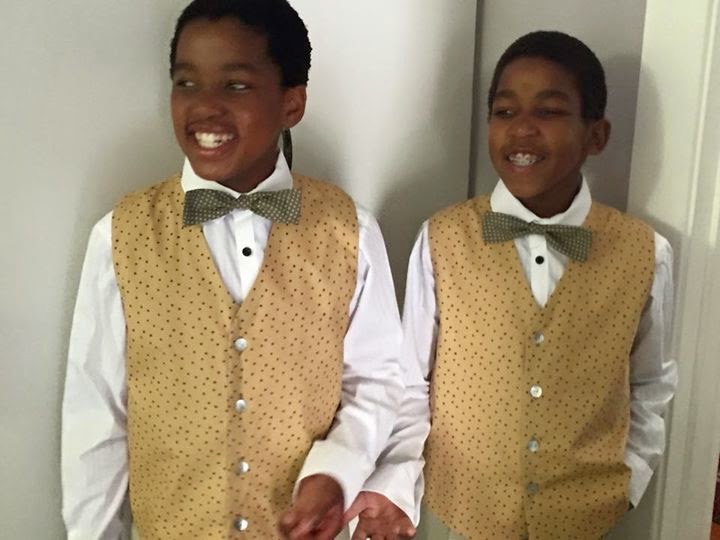
We spoke to you both about us getting married quite a long time ago.  Your reactions were not, initially, very encouraging.  “Oh gross!” you both exclaimed.  “Do we have to come?!” And finally, “Are you going to kiss?!”  But your views seem to have mellowed a little since then.  Gabriel, you baked a rainbow cake and iced it in white and suggested that we have the same for our wedding.  Joshua, you got very enthusiastic about what we were all going to wear and demanded red takkies for your shoes – not to mention matching braces.

We have come a long, long way.  Leon and my journey to this point has been almost 16 years, and our parenting has been almost 13 of those 16 years.  You have been with us for most of our relationship so far.  It is extremely difficult for me to remember what life was like without you.

I remember my own shock, when it became clear that Leon wanted children.  It was never something I had imagined for myself, believe me!  I balked at the idea of endlessly changing nappies and shoving spoonfuls of mush from bottles into gaping mouths.  I asked myself (and him!) what was the point of being in a gay relationship, if one was going to ruin it with children!  But I also listened to him.  I’m sure I was no different from any marital partner who discovers that their life partner wants children.  I listened. 

Leon made it clear that this was a non-negotiable for him.  He had to have children.  And from the moment I heard what he was saying, my life was turned inside-out and upside-down.  Because children are very different from puppies or kittens.  They start reading you from the moment they see you.  They analyse all your good and all your bad.  They take everything in and then they take over the whole of your life.

Gabriel, I can remember when we first met.  Leon called me excitedly to say that the Princess Alice Adoption Home had called him to say that they had a baby who they thought might be right for us.  I raced there.  I wanted to meet you myself before I made any decision.  I was told where your cot was and I sat beside you.  You lay there quietly, sucking your middle finger and watching me.  Analysing me.  Assessing me.  We sat like that for quite a while.  I put out a finger and you took hold of it with your other hand.  And that is when it happened.  I became your father from that moment.  From that moment my being was entirely and forever changed.  From being just an ordinary man, I became a father.

They say, when you are adopting children, in the legal documents, that this child which you are adopting is “as if born from you”.  I can tell you both, Gabriel and Joshua, that this is true.  You are both “as if born from” Leon and me.  There is no other way of putting it.  When we first met you Joshua, the social worker brought you into the tiny office she was working from.  She put you first on Leon’s lap and then after a while, Leon passed you on to me.  You were watching us both intently.

You were reading us, assessing us, forming your very strong opinion of us.  And it was then – right there in that office – that you became our son and we became your parents.  In a single moment of time.  In an instant.  It was that quick and that powerful.  You were “as if born from us”.  When I look at you, I see myself.  That is just the way it is.  It isn’t complicated.  It didn’t take forever.  It required no effort at all.  It happened there and then.  Just like that.

And so it was that the two of us started the parenting journey that has really defined most of our lives for the past 13 years now.  We got used to the nappies.  I got used to the occasional projectile vomit.  We worked our way through the pre-school and the early years, trying to do the best we possibly could for you both.  But what is seldom recognised is that you have not just been passive participants in all of this.  You have lived your lives with us too.  You have had to put up with our weaknesses and faults, along with our strengths.  You have had to tolerate our irritating ways and our foibles.  You have had to accept that we are very distinct individuals and we often have very different (and probably very confusing) views on just about everything.

You have given us completely unconditional love.  You have comforted us when we were low.  You have laughed with us, when we were happy.  You have tolerated our latest ideas and survived some of the worst of them.  You have built our family together with the two of us.  Solidly, steadfastly, through easy and through seriously difficult times.  You have co-built what we have together.

What the legal documents about adoption don’t make reference to, is the way in which adopting a child will change you – and how it will do so irreversibly.  Because my life – our lives – can never be the same again, since you came to live with us.  You have shown me things I would never have known.  You have given me more joy than is possible to describe.  You have given me more to be proud in than I would ever have achieved in my own life.  You have shown me an aspect of love that I would never have known, without you in my life.

So when people have asked your other dad and I, why we have waited until now to get married, we have answered “because it feels right to us to do it now”.  Both of you are old enough to understand what we are doing in getting married.  Both of you are old enough to be fully part of it.  Our marriage is between the two of us, but a large part of us – is you.

Our wedding was a celebration.  All the people who came there, were people who are deeply connected to our lives.  Our families; our friends, from near and from far; our colleagues from work; some of your friends and the parents of some of your classmates.  It was a wonderful celebration of our life together.  We are so lucky to live in a country where our family is legally recognised.

These are things which have been fought for.  They did not come easily, or automatically.  They have been the fruits of struggle.  For some of our family members, it has been a difficult thing.  For some of our friends, the same.  For some of our colleagues also.  These are not always easy things.
But, in general and in relation to everything that matters, the support we have received has been overwhelming. 

We wanted to celebrate our love in the communion of our friends and loved ones.  We wanted you to experience that love – that joy – that acceptance and that support, which we know surrounds us.  It is a wonderful thing, which we can all depend on.

The fact that we are married now, doesn’t really change much.  Breakfast is still going to be breakfast.  Homework is still going to be homework.  I am probably still going to be grumpy more than I should be.  But what has changed is the fact that we are now publicly, openly, in overwhelming celebration – a wonderfully supported family.  If families as happy and as complete as ours are not public – then who should be?  We celebrate the house we have built for ourselves.  We celebrate our commitment to each other and our love for each other.  That is what we did, when we married each other last Saturday.

We chose the name Gabriel, for he is the bearer of good news. We chose the name Joshua, because he is the one who leads people to complete their journey.  We chose them both because of the cultural tradition from which we have come and which forms a dominant part of our milieu, (for better or for worse). We are all what we are.  We can only try to live up to the ideals we set for ourselves, not those which have been set by other people.

But here, now, at this really important moment, let us all reflect on the wonderful thing which we as a family have built together.  May it continue to change to suit all of our very individual and different needs.  And from us as your parents, you can depend on our love for you as we grow in love for each other.  You can depend on this, for as long as we are alive to give it.

All my love

Your dad


Michael

Wednesday, January 9, 2013

The New Normal


Stephen Mulholland has got a lot of people upset, with his recent article in the Sunday Times, titled:Same-sex parents have a special duty to their children”.  I would say, he isn’t wrong.  We do have a special duty to our children – but not quite in the way Mulholland imagines.

Bringing up a child, no matter who you are, isn’t the easiest thing.  The manuals are both incomprehensible and dull.  Anyone around you who has ever had a child is quicker with the advice than with actual help.  It is a lonely sea and you have to paddle it pretty much on your own, on those bleak nights when projectile vomit hits the ceiling and temperatures soar off the charts.  Of course there are the “Little House on the Prairie” moments as well, when all is sweetness and such dazzling light as one could never hope to imagine, let alone describe.

But generally, children of whatever age are a bit of a slog.  You have to hammer away at their spelling and reading and vocabulary and maths.  If you don’t, like a neglected work email inbox, it starts to become impossible to recover the lost ground. You have to bandage the grazed arm, you have to calm their fears.  You have to take them to school, you have to make their supper and then get them to eat it. Being gay or lesbian is neither here nor there, since one does none of these things using one’s sexual organs, or any combination of them.

Each phase has its wonders and each phase seems to have its slog.  It is the dreariness of dealing with nappies and tasteless food that comes out of very expensive bottles in chemists; it is the fighting for space in bed; it is the explaining things over and over again – because, as a friend of mine once said to me long, long ago – “You have to teach them everything!”

Yes – everything.  And what she forgot to tell me is that you have to un-teach them a hell of a lot of things as well.  We have to explain to them that the world is sometimes a very hostile place – where children will laugh at them because of who they are, or because of who we all are as a family.  And we have to explain to them that those children have learnt their cruelty and their bigotry and stupidity from their parents.  And it is very likely that they learnt it all from their parents in turn.

We have to teach them how to deal with a world where some people think it is fine to be one thing and not fine to be another, whether because of race, or religion, or accent or gender.  We have to teach them tolerance, even of the idiotic many who are so terribly comfortable – so unchallenged – so unruffled.  We have to teach them these things, not because of who we are but because of what the majority is, and how it thinks (or doesn’t) and behaves.

So yes, I think Stephen Mulholland has a point, bumblingly made, albeit.  Gay and Lesbian parents need to do a great deal to protect our children from rampant and openly confessed heterosexuals.  They are a dangerous breed, by and large.

And it is the case, holding as they do, a majority of such huge proportions, that they can behave as though there is no-one else on the planet.  They can define what is “normal” and what is not.  They can demand obeisance to the gods of “family values” and “common sense” and “religious principles”.  And they can persecute those who do not conform to a binary view of gender, sex and sexuality.  And they do.  I need not cite the terrible details.  That is what is “normal” in the world in which we as lesbian and gay parents live with our children.

It is not his patronising attitude which worries me.  (I would much rather be patronised than ignored).  It is not even his short-sighted and bigoted conclusions which he reaches on the basis of no discernible argument.  What worries me most about Stephen Mulholland is that he is so god-damn smug and self-righteous about himself.  He speaks, perched so comfortably on the summit of Mount Self Content.  His speaks a hetero-normative tongue, because he simply has never heard any other language.  That is what worries me.  And he is not alone.  You, dear reader, are likely to be with him too.  Now put yourself in my shoes, as a parent.  Would you not have your work cut out for yourself?

Tuesday, October 11, 2011

Hidden meaning

The story which my son read to me today was fairly shocking. I suppose it wouldn’t have been shocking in 1923, which is when it was written, by a man called James H Fassett. The forty-eighth edition of the reader, called “Briar Rose” was the edition my son was reading from.
I started feeling a bit uneasy with the title – “Escape from Red Indians” and my alarm grew as the story unfolded.

“Many years ago”, it began, “two boys lived on a farm in America. It was so long ago”, the story continued, “that there were very few white people in that country”.

“Indians” lived very far away in the woods, but occasionally, they would “come down to where the white people lived and capture any white person whom they could find”.
It went further in setting the scene. “White prisoners would be taken to the Indian villages and would be held there as captives”.

The story is about how one child, "John" – a white innocent of course, was captured by savage Indians. He had his skates with him at the time of capture. The Indians thought the skates “must be some of the white man’s magic”, so they ignored them.

There are then descriptions of the savage conditions in which the Indians lived and John was given to an Indian mother, who treated him “as if he was her own son”.

John was of course very brave and astonished his savage peers with his bravery, even in stick fighting and the use of bow and arrow. However, because he was white, the Indians made him go with the women “squaws” to hoe. John had learned from his Indian peers that hoeing was for squaws and not for warriors and so he quickly rebelled. He had learned to “speak their tongue” but they nevertheless did not trust him.

On the day of his escape, the river had frozen over and so he brought out his skates and put them on one of his peers, who fell about on the ice, much to the merriment of everyone. There was much hilarity and mirth. When John put the skates on, he too fell about, pretending to do the same as all the other non-skaters.

Then, when he was far enough away from everyone, he skated off into the sunset down the river, towards the sea (because he knew the white people lived near the sea), found his parents again and lived happily ever after.

Now, besides the fact that this story belongs to a completely different time, I ask myself, is it appropriate in the South Africa of the 21st Century, for our children to be reading such stuff? There are all the usual facets of colonial writing in it: the glorification of whites and the demonization and idiot-ization of everyone else. More than that, the sexism of the time is simply assumed along with the unquestioned fact that we all belong with “our own” and should stay with “our own”. Indeed, we are safe with “our own”, happy with “our own”, and constantly in danger of being attacked and abducted by “them”. It is typical frontier storyline. But is it appropriate for children who are trans-racially adopted, in a country whose constitution guarantees the rights of everyone to live in dignity and peace – such as mine are? More than that, is it appropriate for any children for that matter, transracially adopted or not?

It is in these standard ways, where stories are told without questioning their content, that prejudice gets passed on down the line. I can only conclude that it is either laziness on the part of the school, or a simple lack of the most basic content interrogation, which allows this kind of story to be amongst the instruments of learning in a school, in Africa, some 88 years later?

Sunday, August 28, 2011

To protect or not. That is the question


When you get the newspapers delivered to your house in Cairp Tahn, they are always wrapped in plastic. It doesn’t matter what time of the year it is, sudden, tremendous and unexplained downpours are possible. If people could walk around wrapped in plastic all the time, it would be the preferable thing to do, for the same reason.

So, when I collected my Sunday newspapers from the driveway this morning, and tore off the standard plastic wrapper, there was nothing unusual about it. In fact, there is a kind of delayed gratification thing which happens – because you don’t get to see the headline, until you have done so. So, I tore off the plastic wrapping and ceremoniously opened the newspapers.
I could not really have been prepared for what I saw. A picture of a white man, with a hunting rifle, kneeling over what appeared to be a dead, black, child – as a hunting trophy.

I read the story, my head reeling. It appears that this lunatic has a Facebook page with this picture on it. He calls himself “Terrorblanche”. But he is not alone. He has some 590 friends, on Facebook. So, there are at least 590 people out there, who would actively press the befriend button, to link themselves with a person who would post this picture on his page.

I went to his page, to see what kind of a person this might be. He describes himself (I presume he is a he) as having matriculated at Krugersdorp High School. He is self-employed. He likes Bok van Blerk, Leon Shuster and Afrikanse Musiek, amongst other things. His activities are self-defence and close combat fighting. His lists “knifes”, firearms and weapons as his interests. He has a picture of the original Eugene Terreblanche riding a horse, with the flag of his right wing organisation unfurled. So, in all likelihood, the man is close to psychotic.

Now, the immediate problem we, as parents, needed to deal with was, what to do with the picture on the front page of the newspaper? Do we leave it lying around? Do we hide it? Do we leave it lying around in the hope that they would not see it? What would we say if they did see it?
On a recent holiday to the Devon, in the UK, we went one day to visit Exeter Cathedral. As we arrived, a memorial service for a child was just ending. There was a picture at the entrance of the child, who had drowned and the body had not yet been found. Our eldest child, Gabriel, was extremely interested. Who was the child? Why did he die? More and more questions. And they continued for the rest of the week, because each day, there were more pictures of the child on the front pages of the newspapers – until eventually the body was found.

Our child was clearly dealing with the reality of death. Not for the first time, but this time, it was the death of a child he was dealing with. We explained that death is as natural as birth. That yes, we all have to die sometime. That some people die younger than others. No, only a very few children die at a young age, and it is usually because of accidents, like this one. No, we as his parents are probably not going to die very soon.

These were normal worries and fears, which any child goes through – and especially for an adoptive child. We dealt with them, as best we know how. Honestly and un-emotively. Telling him the truth, without the embellishments of afterlife and religion and bargaining. The moment passed, as is right.

But this! This is a picture, (which is probably staged – but then how does one explain to a child why it is staged?), where it looks as though a black child has been shot by a white game hunter – for sport! It is on the front page of the Sunday newspaper. That, I am afraid, I simply can’t explain. So, for better or for worse, we hid the page, from our two black children.

Monday, October 5, 2009

Trans-racial togetherness

After much to-ing and fro-ing we were invited to attend what was described as a “trans-cultural” adoption group yesterday. Now, what might a “trans-cultural adoption group” be, you ask me?

Well, this particular group was one where white single mothers, who have adopted black children have got together on a monthly basis – for reasons of support, I suppose. I would have called that a trans-racial adoption group. The fact that they call it a trans-cultural adoption group is cause, I would say, for some concern. It goes back to the substantive matter of whether or not culture is racially defined. This, after all, was one of the fundamental tenets of apartheid ideology – that we are all racially and culturally separate-able and circumscribable. It then took it further. It said that culture was something fixed for all time. It was something which was defined primarily by skin colour, and once defined, it was something one could not escape.

Now, to assume that the culture of the children in this group - because they happen to have black skins - is of a different culture to the parents with white skins, to my mind, is highly problematic. There was even some casual discussion, in the group of nodding in the direction of the “culture” of a particular child. So, I heard that one child’s biological background was Zulu. I wonder what, in reality that is going to mean for the child? Lessons in Zulu dancing? I discovered, when I did a DNA test of myself, that I had Croatian roots - what on earth does that mean in my life, other than vague curiosity?

We were invited to the group somewhat curiously, being neither single nor mothers, you understand. We went, because we feel it is in some way important for our children to understand that they are not alone in the world – that there are other families like ours. But the problem is, what happens when there are some fundamental discordances relating to values? Is that something we want them to be exposed to as well?

As it was, the leader of the group revealed that there was some issue about us being a same-sex couple. Apparently there was some discussion in the group about having men in the group, because there was a lack of male role-models. When our names came up, apparently, one comment was “but do we really want two gay men in the group?” Again, it is really a question of values. Of course, in the real world, our children are going to need to realize that not everyone is accepting of gay men parenting children (trans-racial or not). But do we want to belong to a group where some of the parents are not completely affirming?

It’s difficult. This is, after all, Cairp Tahn. This is one of the most racially divided spots on the African continent. So, there is some sense in taking what is on offer. But does that mean that values need to be compromised as well? I really don’t know. I suppose I also have some missionary zeal left in me, which means that I still feel constrained to convert the infidel, but does one do that in the context of one’s children? That is a question which we will be considering in the next while, for sure.

Sunday, September 6, 2009

Trans-racial parenting

Pic - Getty Images
I have written quite about this in this blog before - so I was interested to read a satirical article recently on the site "Parent 24" by Sipho Yanana, entitled "My white son", where the author (black) contemplates adopting a white child - and how that child would be brought up. The article itself is really good - but the comments, or some of them at least, are fairly indicative of the state of intellectual play about this issue.

However, an interesting aside. Our childminder came home today, after a weekend of Zionist church services (which involves, she tells us, singing, praying, dancing and tea drinking - tea without milk or sugar - which is described as the "Tea of life"). She got a lift with a fellow Zionist, who is apparently also working for two white gay men who have adopted children. Except, in this case, the children which have been adopted were imported from Europe, and are white.

I remember having pause for thought, many years back, while I was living in the UK, when I heard that social services there would not allow adoptions trans racially. I wondered, for a moment, whether this might be racist. But thinking about it, I came to realise that, it probably is not. We do not, after all, live in a perfect world. And the needs of the child, of course, need to be paramount. I discovered, when we were going through our own adoption process, that even here in South Africa, social welfare will try, as much as possible to pair like with like. So, for instance, if there is a black child, black parents will be preferred. If there is an Indian child, a coloured child - these would be matched, as far as possible with their racial equivalents.

Of course, it isn't always possible - and then the default position is to match a child with loving, willing and able parents, rather than let the child languish in a home. And I think also, though it was never said, that if a child can be placed in a heterosexual home, that would be preferred to a same-sexed arrangement.

And the reason would be this - that it is just easier! It is much easier not to stick out like a sore thumb in public. It is much easier not to have to explain why you are a different colour from your parents. It is much easier to be in a "normal" environment, than one which is uncommon. That is why it would be preferred.

What do I think about that? I think it is probably correct. Does that mean that we should put an end to trans-racial adoptions, or adoptions by homosexuals - not at all! But I don't think we should be so naive as to ignore the problems, both potential and real.

The link to the article is

http://www.parent24.com/Content/Getting_pregnant/adoption/2151/2ee5d683100f4ac6b86695187a065fdf/31-08-2009%2011-08/My_white_son_

Sunday, August 9, 2009

A new child

Jacqui and her new son Amila

The moment - Jacqui's mother, Bernadette and brother Andrew holding Amila.
My friend Jacqui has just adopted a child. The waiting for this moment has been long and laboured. I wonder why this seems to be the norm? I wonder why, in a country wracked with HIV, poverty, unemployment, violence and often completely unthinking sexual behaviour, it seems to take the social services so incredibly long to sort out the match between obviously able parent and obviously needy child?

It was really no different in our case. Despite that fact that I kept on changing my mind about it, when all was said and done and decided, we still had to wait months and months for our first child. And the second spent months and months waiting for us apparently, because we could have taken him three months before he actually was given to us! Those three extra months, were fairly critical in his development. When 6 month old Joshua arrived, he was a bit like a zombi. He seemed to have no emotions. He just stared around him - never crying, or gurgling, or doing any of the other social things which babies of 6 months are supposed to do.

Luckily, the light did switch on - and Joshua today, is the most animated child imaginable. But there has been damage. His motor movements are not what they should be. His writing and drawing is extremely bad and he needs Occupational Therapy to see him right. All because of the level of under-stimulation which he received in those crucial early months.

Jacqui's little boy (named by his birth-mother, Amila) has been in foster care - and though this might mean that he has other problems, he certainly does not seem to be under-stimulated. He is bright, alert, aware and self-confident. A beautiful little boy.
As we sat there, in Jacqui's maginificent Hout Bay house, overlooking a wonderful valley, amongst her friends and family, I could not help think back on the welcome parties we had for both our boys, some 6 and 7 years ago now, and started to enumerate in my mind the absolute joy which these children have brought into our lives. As I have said before, in previous postings, I may not be the world's most natural parent, but our children have undoubtedly made me a better, a more fulfilled person. A more whole person. That is what children can do, it seems, if you let them.
I remember the first time their grandparents met our eldest child, Gabriel. What we were doing was not the expected. It was, perhaps, not what they had dreamed for their son. They came from Harding - a tiny town in KwaZulu-Natal. Their exposure to situations like this was limited. But if they did have difficulties, though, they had determined they would overcome them. And they have proved themselves to be the most supportive and most loving of grandparents through the years.

I watched as Jacqui's mother arrived, also from KwaZulu-Natal, to meet her grandson for the first time. I watched her eyes, as they first set eyes on her new grandchild, Amila. If there was uncertainty before, (and there must have been) there was none at that moment. Because immediately, the bond had happened. I spoke to Jacqui about this two nights ago. I said to her, wasn't it amazing how that thing happens? That thing which is hard-wired into our make-up as human beings. The way in which once you meet your child, you change as a human being. You cross from being an observer, to being a player. From being a relative, or a friend, or a helper, or a next-door-neighbour, to being a father or a mother. The switch is thrown. You will never be the same again. And then a grand-mother or grand-father. You have changed into something else. You can't ever go back.

On our children's birthdays, Leon and I write a letter to them in a book. We write about what is happening around us and what is happening in our lives. We write about our pains and our sorrows and our joys and our pleasures. We tell them about themselves - what we see in them; what we hope for; what they have done in the past year; what they have said, what they have achieved. We will give it to them, when they are 21, as a word-scape of our journey together. Because it has been, so far, a wonderful one.

Our children, Gabriel and Joshua, are both very different from each other. I have no doubt that they will journey on very different paths. But, for sure, the one thing which will bind them together is Leon and me, and our family and families. That is a constant they can rely on.

And so, Jacqui, I welcome you to this strange and bewildering state of being that is parenthood. I know, without any doubt that you will face both joy and anguish. You will know love (like you have never known it before) and moments of the deepest despair. And above all of that, you will experience the thrill of guiding another human being on this exciting path called life.

Friday, July 31, 2009

Gay-friendly fairy stories

Some years back, I went to fetch my son, Gabriel, from his school for a doctor’s appointment. Now let me explain – Gabriel is adopted. He is black. I am white. The school he went to then was almost completely black, barring most of the teachers.

So, I arrived. My younger son, Joshua the extrovert (at the same school, also black, also adopted and, I suspect closely related to Osama bin Laden) rushed up to greet me. Gabriel is much more reserved. He was not unpleased to see me, but concerned, I think, to look in control of the situation. He sauntered up to me, case in hand, and as we left, I heard one of the children shout “Joshua and Gabriel’s daddie is white!”

Now that, I suppose, is a fairly big issue, in an almost all black school. The good thing about them going there is that they consider us (my white partner and I) to be the strange ones. They, on the other hand, are very comfortable in their skin. On the question of my partner and I both being male, we had some nervousness initially, about the school, when one of the kids came home one day saying that they had been talking about families at school. We phoned the school first thing the next morning. We wanted to know whether there might be any difficulty with our situation. “Oh no!” Said the principal, “The class was talking about who had a daddy and who had a mommy and things like that. And Gabriel was pleased as punch, because he had two daddies and most people in his class had none!”

We have sometimes wondered how we should handle the matter, should it come up, with the kids. The other day it did. Joshua at dinner, one evening, suddenly started talking about his mommy. We all turned to him, wondering what he was going on about. On he went – his mommy this and his mommy that. His brother had been quietly considering him for some while. Suddenly he shouted at him “You don’t have a mommy! You have two daddies!” Joshua shut up and that, in a nutshell, was that!

I was interested to read, some time ago, about books which are now being introduced in UK schools, introducing children from as young as 4, to gay and lesbian issues – the so-called “No-outsiders” project, which ended in March 2009. Naturally, conservative religious groups and people are huffing and puffing. “It is tantamount to child abuse!” said one. “It is propaganda designed to warp children’s minds”, said another.

Now our connection with the project is, I admit, slight. But it was enough to make me read the article with some interest. My partner has been very concerned, from the beginning, that our children should grow up seeing themselves (and us) as normal - as indeed, we are! Our family is as “normal” and “ordinary” as you can get. The kids get up every morning, have their breakfast and go to school. When we get home from work, there is the usual stuff that happens in every home with children. Joshua "bin Laden" gets shouted at because he is breaking something; there is a fight over eating healthy things on their plates and bribes with ice-cream to follow if they do; there are demands for cooldrinks after the magic hour of 5pm, indeed there is extreme resistance to going to bed at 8.00pm - and so it goes and so it goes. Just because one of us doesn’t wear a dress as parents, doesn’t make the slightest difference to the sheer normality of the situation.

And there is the bed-time story. My partner scoured the internet and found several storybooks which we read to them, along with Cinderella and Jack-and-the-beanstalk and all the other usuals. One is called “And Tango makes three”, which is a sweet (apparently true) story about two male penguins in the New York zoo. The zookeeper notices that they don’t seem to like the girl penguins very much and instead seem to prefer each other. They set up a nest together. Together, they try to hatch an egg shaped rock unsuccessfully. The kindly zookeeper takes pity on them and puts a real egg in the nest which they made for themselves – which they successfully hatch this time and raise a healthy chick called Tango – because it takes two to tango.

Another is called “King and King”. An elderly Queen decides she has had enough with ruling and that her only son should take over. She arranged for all the likely Princesses in the land to process before him, so that he can choose a suitable Queen for himself. No-one seems to catch his fancy. Would-be Queen after would-be Queen comes and goes. The son and heir is bored to distraction. But one day, a young hopeful just happens to bring her brother with her for support, and it is love at first sight! They get married and everyone lives happily ever after. And everyone called them King and King!

The last one is called “The Sissy Duck” and it is about a male duckling who likes cooking, cleaning and art. Now, as I say, we read these to the children periodically, mixed in with all the other favourites. I can’t say that they leaped up and down with enthusiasm when we read these particular stories, but they each had their own favourites and prefered those to all others.

And the point of it all? Well, just that what we are doing, and the life we are living - feels terribly ordinary. Because that is what it is! And it is both a pity, and I would say ridiculous, that there isn’t a range of literature and other support mechanisms, which would help to support that ordinariness.

My partner recorded bits and pieces on the TV about the Ellen Generis marriage. We encouraged the children to watch - giving no comment. His point was that they need to see that who we are is not something odd or entirely unusual. There are other people in the world who are also engaged in the same kind of relationship that their parents are.

I had a discussion with the Gabriel, the oldest child, not so long ago. I asked him whether his friends at school ever ask him where his mother is? he said some did. I asked him what he answered them. he said "I tell them I don't know where she is". Isn't that brilliant?! Because he doesn't, and neither do we!

And that is why I think the UK Education department seems to have managed to get things right. I have no doubt we will get there in the long run, but it is a real pity that it seems to be taking so long. Because same-sex child rearing is hardly new – but it is going to become much more evident, now that marriage (or civil union) is legally permitted. That is just a very plain, simple, fact of life.

And the fears that people have of corrupting children through educating them to different lifestyles, is just plain irrational. What I fear, deeply and not irrationally, is the consequences of not educating children – because what happens then is bullying, hatred, teasing and hurt. All because they don’t know any better.

I am just waiting for the same-sex fairy story, which has children of a different race from their parents in it, to feel really covered!

Tuesday, July 7, 2009

Trans-racial parenting

My children are black. That is an accident of their physiology, as much as my relative paleness is of mine.

We have, in our employ, a childminder, who comes originally from Venda. Venda is famous for, amongst other things, Mopani worms. One day, I arrived home from work to find my eldest child chewing on a large, seemingly juicy Mopani worm, which he had demanded from her plate. My personal reaction was revulsion – but he seemed to be enjoying it, so no harm was done and I made no comment. I notice that today, 7 years later, Mopani worms do not seem to feature on his list of favourite foods. They could, because they are still infrequently present in our household, but they don’t.

When we were living in Johannesburg, our children attended a mostly black pre-primary school. The accent of the eldest child was that of a non-model “C” black South African. Very unlike mine, which, although not Queen’s English by a long shot, has been accused of being slightly “posh”. Our other son, who attended the same school, seemed to have an accent more like ours. When we moved to Cape Town, it took two weeks before the eldest child spoke in a broad and immediately recognisable “Cape flats” accent. The other maintained what he had before. Both children again went to the same school.

My point? Culture, and everything that goes with it, is learned behaviour. It is not somehow connected to one’s DNA. Their culture isn’t somehow connected to their colour. If my eldest child doesn’t eat Mopani worms, it is not because he hasn’t been exposed to them, but because the dominant culture in which we live, as a family, doesn’t expose him to them often enough for him to want them. If he is now speaking with a Cape flats accent, it is because that is the dominant accent he is exposed to at school and one which appears to help him fit in, whereas the other child doesn’t seem to have the same kind of needs.

When we adopted the children, the legal wording of the adoption order was, for me at least, very important. It said that this child was now “as if born to you”. The ancestors of that child, (and the state) for whatever reason, handed him over to me and my partner. They were not “abandoned”. They were consciously and lovingly handed over. Those children are now mine - “as if born to me”. They now have two white fathers.

Now, just because of the fact that these children happen to be black and me white, do I need to start a course in gumboot dancing? Should I rush off and get myself circumcised? Should I have a regular supply of Mopani worms in the house to make him feel secure? This is as crazy as it is bizarre and it reveals, I am afraid, just how far we are away from a really non-racial society, where colour is the least significant thing about a person.

No, we are not there yet. And yes, I have no objection to “exposing” my children to cultures other than my own, (which is the reason, by the way, that we were at a friend’s ancestor do!) But I also have no illusions about the difficult path they will need to tread. They need to be secure, not in some fantasy culture from somewhere else, but in their own skin, for who they are. And force-feeding them Mopani worms may not make it easier for them. It may make it a whole lot worse.